What is periodontitis?
Periodontitis is a chronic inflammatory disease of the tissues that support the teeth: the gum, the ligament and the bone. It is triggered by the bacterial biofilm (plaque) that builds up along and below the gumline, but it is the body's inflammatory response that gradually destroys the attachment and the bone. Left untreated, teeth can lose support, become loose and eventually be lost.
It usually follows gingivitis, a superficial and reversible inflammation of the gum. Not every case of gingivitis progresses to periodontitis, but every case of periodontitis starts with inflamed gums. The key difference: gingivitis has not yet destroyed the attachment, periodontitis has, and lost bone does not grow back on its own.
The disease is often silent at first. Warning signs include:
- gums that bleed when you brush, covered in our article on bleeding gums;
- persistent bad breath;
- receding gums and teeth that look longer;
- gaps appearing between teeth;
- a tooth that moves or changes position.
Diagnosis: probing and X-rays
Diagnosis relies on a detailed examination called a periodontal assessment. The dentist gently slides a graduated, round-tipped probe between tooth and gum at several points around each tooth. This measures pocket depth and attachment loss and records bleeding, tooth mobility and involvement of the areas between molar roots (the furcations).
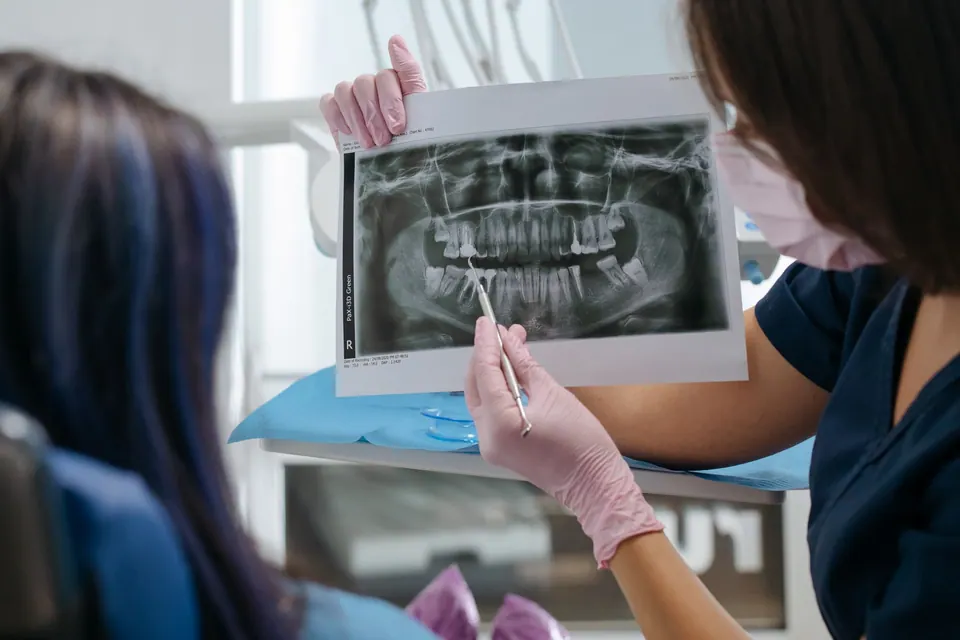
This charting is completed with X-rays: a panoramic image gives an overview, while more targeted periapical images show the bone level around affected teeth in detail.
The dentist also gathers the medical information that matters: smoking, diabetes and how well it is controlled, medication, and any family history of early tooth loss. These factors directly shape the diagnosis and the treatment plan.
Understanding the stages and grades of the 2017 classification
Since the 2017 classification of the EFP (European Federation of Periodontology) and the AAP (American Academy of Periodontology), periodontitis is described much like other chronic diseases: by a stage, an extent and a grade.
The stage describes severity and complexity:
- Stage I: early periodontitis, with limited attachment and bone loss;
- Stage II: moderate periodontitis, clearer bone loss but no teeth lost because of the disease;
- Stage III: severe periodontitis, deep pockets, furcation involvement and possible loss of a few teeth;
- Stage IV: severe periodontitis with loss of many teeth, mobility, drifting, and the need for complex rehabilitation of chewing function.
The extent indicates whether the disease is localised to a few teeth, generalised, or follows a particular pattern affecting the molars and incisors.
The grade estimates the rate of progression and future risk:
- Grade A: slow progression;
- Grade B: moderate progression;
- Grade C: rapid progression.
Smoking and poorly controlled diabetes can raise the grade. So "generalised stage III, grade B" means a severe disease affecting the whole mouth and progressing at a moderate pace.
Non-surgical treatment: the essential first step
European EFP guidelines organise treatment into successive steps. The first two are non-surgical and apply to every patient.
Step 1: controlling biofilm and risk factors. The dentist shows you where plaque remains, adjusts your brushing technique and the choice of interdental brushes, carries out scaling above the gumline and discusses quitting smoking and diabetes control. Everything else depends on this step: without effective daily cleaning, even the most careful treatment will not last.
Step 2: subgingival instrumentation. Often called root planing or deep cleaning, it involves cleaning the roots at the bottom of the pockets under local anaesthetic, with ultrasonic instruments and hand curettes, in one or more sessions. In some forms of the disease antibiotics may be added, but they are not routine and never replace mechanical cleaning.
After a few weeks of healing, a re-evaluation measures the pockets again to judge the response.
When is gum surgery needed?
When deep pockets remain after well-conducted non-surgical treatment, step 3 may be proposed. Residual pockets can first be re-instrumented. If they stay deep, surgery gives direct access to the roots and bone:
- access flap surgery: the gum is opened so the roots can be cleaned under direct vision, then repositioned;
- resective surgery: reshapes bone and gum to eliminate the pocket, in specific indications;
- regenerative surgery: in certain vertical bone defects, materials such as enamel matrix derivatives, membranes or bone substitutes help rebuild part of the lost attachment.
In stage IV, treatment often combines periodontology with other disciplines: orthodontics to reposition drifted teeth, splinting, and crowns, bridges or implants to restore chewing. Well-planned gum treatment always comes before this rehabilitation.
These procedures are generally carried out under local anaesthetic. Moderate swelling and a few days of discomfort are usual, along with a soft diet, adapted brushing of the treated area and a prescribed mouthwash while it heals. Smoking clearly slows tissue healing: stopping improves the response to both surgical and non-surgical treatment.
Maintenance: the key to long-term results
Periodontitis can be stabilised, but it is not "cured" in the sense of disappearing for ever. Step 4, supportive periodontal care, is therefore as important as active treatment. It consists of regular check-ups and professional cleaning, at intervals set according to your stage, grade and home care, often closer together than for someone with no history of the disease.
At each visit, the dentist re-measures the pockets, identifies bleeding sites, reinforces hygiene advice and steps in early if the disease flares up. Patients who keep up this maintenance generally keep their teeth far better than those who drop out.
Periodontitis is also linked to general health. The link with diabetes is the best documented and works both ways, as explained in our article on diabetes and gum health. Treating your gums is part of looking after your health as a whole.
Your gum assessment in Agdal
If your gums bleed, if you have been told your gums are receding, or if a close relative lost their teeth young, a periodontal assessment will show where you stand. The earlier the disease is caught, the simpler the treatment.
At German Dental Clinic in Agdal, the examination includes periodontal probing, digital X-rays and a clear explanation of your stage and grade, with a step-by-step treatment plan. If you live in or around Rabat and would like your gums checked, simply book an appointment.
Frequently asked questions
Can periodontitis be completely cured?
Periodontitis can be halted and stabilised, with gums that no longer bleed and pockets that become shallower. However, lost bone does not grow back by itself, except in some defects treated with regenerative surgery. The disease can return if home care and maintenance slip, which is why follow-up matters.
Is root planing painful?
It is carried out under local anaesthetic, which generally makes it comfortable. Afterwards, sensitivity to cold and mild gum tenderness are common for a few days. The gums may also recede slightly as the swelling goes down: this is a sign that inflammation is settling.
Is periodontitis hereditary or contagious?
There is a family susceptibility: some people react more strongly to biofilm, partly for genetic reasons. Bacteria can pass between people who are close, but the disease is not contagious in the usual sense: it depends mainly on each person's response and on risk factors such as smoking.
Can I have implants if I have had periodontitis?
Yes, it is often possible, but only once the disease has been treated and stabilised. A history of periodontitis increases the risk of inflammation around implants, known as peri-implantitis. Meticulous home care and regular maintenance are therefore essential before and after placement.
How often do I need to come back after treatment?
Maintenance intervals are tailored to you. They depend on the stage and grade of your periodontitis, your home care, smoking and, where relevant, diabetes control. Visits are often closer together at first, then adjusted according to the stability seen at each check-up.
The information on this page is general. Only a consultation allows a diagnosis and a suitable treatment plan.