Guided surgery in brief
Guided implant surgery means planning the implant position on a computer, using a 3D scan of the jaw and a digital impression of the teeth, then making a surgical guide that directs the drills during the procedure. The implant is placed at the location, depth and angle decided in advance.
Its main benefit is not speed but predictability: the future tooth is designed first, and the implant is positioned to support it correctly while respecting the bone, the gum and sensitive structures such as the mandibular nerve or the sinus.
You may also hear the terms computer-assisted implant surgery, or static guided surgery when guidance comes from a physical guide.
Planning the implant around the future tooth
Modern implant dentistry relies on prosthetically driven planning: the tooth to be replaced dictates the implant position, not the other way round. An implant placed simply where the bone is thickest may be stable, yet difficult to restore attractively or to keep clean.
Planning usually follows these steps:
- Clinical examination: gums, neighbouring teeth, bite, mouth opening and general health.
- 3D imaging: cone beam computed tomography (CBCT) shows the height and width of the bone in cross-sections. Your dentist prescribes it when the plan justifies it.
- Digital impression: an intraoral scanner records the surface of the teeth and gums.
- Superimposition: the software aligns the bone image with the tooth scan to create a single model.
- Prosthetic design: the future crown is designed virtually in its ideal position.
- Implant selection: diameter, length, position and axis are set with a safety margin from anatomical structures.
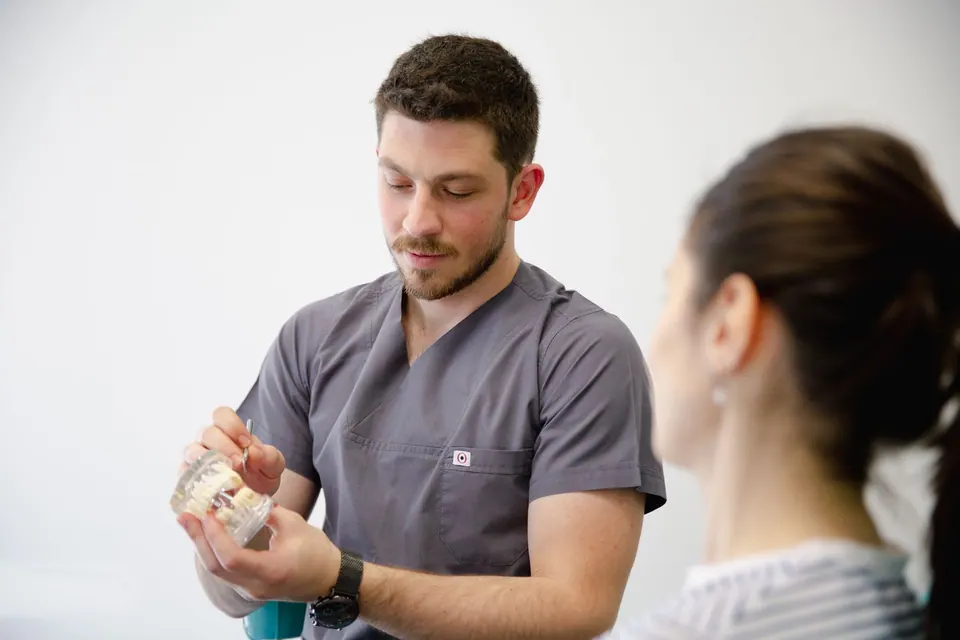
The plan can be discussed and adjusted with you before it is approved. This stage takes place before surgery day. It is often when patients understand their treatment best, because they can see the available bone and the planned position in 3D.
The surgical guide and the day of surgery
Once the plan is approved, a guide is designed and made, most often in 3D-printed resin. It rests on the remaining teeth (tooth-supported), on the gum when the jaw has no teeth (mucosa-supported), or more rarely directly on the bone. Metal sleeves built into the guide control the position and angle of the drills.
There are several levels of guidance:
- pilot drill guidance only, with the remaining steps done freehand;
- fully guided surgery, where every drill and sometimes the implant itself pass through the guide;
- dynamic navigation, a separate technique that tracks the instruments on screen in real time, without a physical guide.
On the day, under local anaesthetic, the dentist checks that the guide fits perfectly and then drills under generous irrigation. When the bone and gum allow it, the procedure can be done flapless: the gum is not lifted, and only a small opening is made where the implant goes.
At the end of the procedure, a check X-ray confirms the implant position. Depending on the case, a healing cap or a temporary tooth is fitted, or the gum is closed over the implant during osseointegration, the phase in which the bone bonds to its surface.
The benefits for patients
Guided surgery offers several benefits when it is well indicated:
- Accurate positioning: ITI consensus conferences recognise that computer-assisted surgery improves accuracy compared with freehand placement, particularly when fully guided.
- Safety near sensitive areas: the distance to the nerve, the sinus or neighbouring roots is measured beforehand.
- Gentler recovery with flapless surgery: swelling and discomfort are often more limited, and fewer stitches may be needed.
- Better aesthetic planning: in the smile zone, implant position determines how the gum holds up and how the crown emerges.
- Temporary tooth prepared in advance: in some cases a provisional tooth can be made beforehand from the digital plan.
For many patients, knowing that everything has been measured and decided before surgery is also reassuring.
The limits you should know
A guide is not an autopilot. Its limits are real and should be explained:
- Some deviation remains possible between the planned and the actual position, due to imaging, guide fit or play in the drills. That is why planning always keeps a safety margin.
- Mouth opening: the guide and the longer drills need space. In the molar region, limited opening can make the technique difficult.
- Bone volume: guided surgery does not create bone. If volume is lacking, a bone graft or regeneration is still needed, and the procedure is then done with a flap.
- Gum tissue: flapless surgery requires a sufficient band of attached gum; otherwise it is better to open the gum to preserve and reposition it.
- Direct vision: without a flap, the dentist cannot see the bone. That is acceptable when imaging shows comfortable volume, less so when the ridge is thin.
- Preparation time: imaging, design and fabrication of the guide add a step before surgery.
Guided surgery improves precision, but it does not replace surgical experience or the ability to adapt if the situation calls for it.
Who benefits most?
Not every implant needs a guide. A single tooth in wide bone, with no sensitive structure nearby, can be treated very safely freehand by an experienced clinician. Guided surgery is particularly useful when:
- several implants are planned, especially for a full arch;
- the implant is close to the mandibular nerve, the sinus or neighbouring roots;
- it is in the aesthetic zone, where a few degrees of angulation change the result;
- an implant is planned straight after extraction, or an immediate temporary tooth is planned;
- a less invasive procedure is preferable because of the patient's health.
The usual precautions of implant dentistry still apply: smoking, poorly controlled diabetes, untreated gum disease and some medications must be disclosed and managed before surgery. Afterwards, the usual instructions apply, as explained in our article on care after an implant.
Guided surgery at German Dental Clinic in Agdal
Guided surgery is one of the techniques used at Dr Fenjero Walid's practice. The assessment starts with an examination and a conversation about your goals, after which the dentist tells you which imaging is needed. The digital impression is taken with the practice's intraoral scanner, and the position of each dental implant is shown to you before surgery, together with the reasons for choosing guided, flapless or conventional placement.
If you live in Rabat and are considering replacing one or more teeth, you can book an appointment for an implant assessment.
Frequently asked questions
Is guided surgery less painful?
The procedure itself is done under local anaesthetic, with or without a guide. The difference shows mostly afterwards: when flapless surgery is possible, the gum is not lifted and recovery is often easier, with less swelling. If a graft or a flap is needed, recovery is similar to that of conventional implant placement.
Is a 3D X-ray always required?
To plan guided surgery, yes: the software needs a three-dimensional image of the bone, usually a cone beam scan, to define the implant position. Your dentist checks that the examination is justified and that its field of view is limited to the area concerned, following the principle of keeping the dose as low as reasonably achievable.
Can I get a fixed tooth on the same day with guided surgery?
Sometimes, but that does not depend on the guide. Immediate loading requires good initial stability of the implant, sufficient bone quality and a well-controlled bite. Digital planning helps prepare a temporary tooth in advance, but the final decision is made during the procedure, once stability has been measured.
Can the guide get it wrong?
The guide reproduces the plan faithfully, but small deviations are still possible because of imaging, guide fit or the instruments. That is why planning keeps a safety margin from the nerve, the sinus and neighbouring roots. The dentist checks the fit of the guide and remains ready to adapt the procedure.
Is guided surgery suitable if I have little bone?
It helps make the best use of the existing bone, for example by choosing a suitable angle or length, but it does not create bone. If the volume is insufficient, a graft or bone regeneration may be needed before or during implant placement. The 3D assessment shows this before the procedure.
The information on this page is general. Only a consultation allows a diagnosis and a suitable treatment plan.