All-on-4 and All-on-6: what are we talking about?
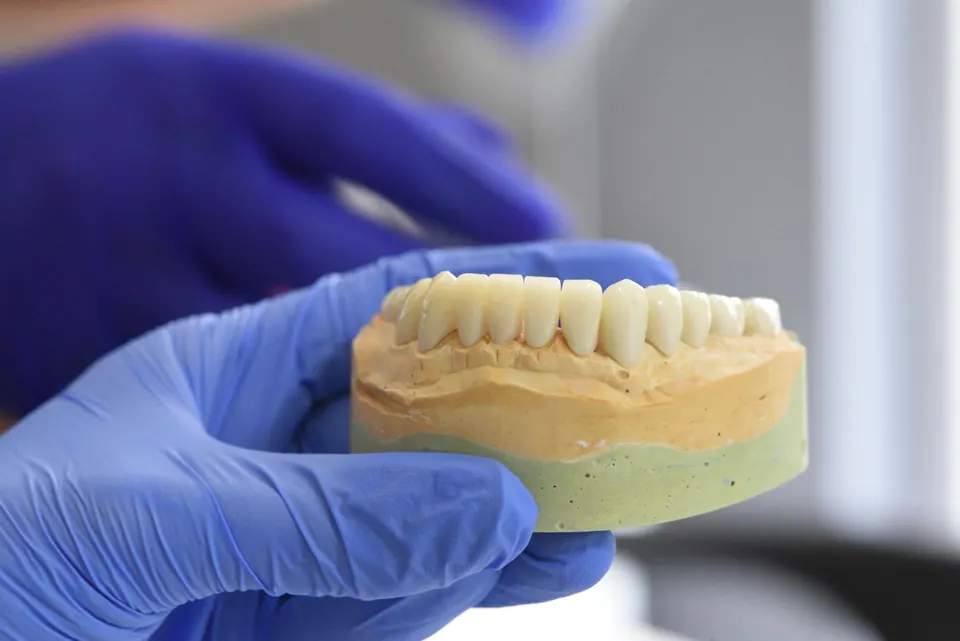
All-on-4 and All-on-6 refer to a fixed full-arch bridge screwed onto four or six implants in the same jaw. It is intended for people who have lost all the teeth in one arch, or whose remaining teeth can no longer be saved. The bridge is not taken out at home: you clean it like natural teeth, with a few extra tools.
The name All-on-4 was popularised by an implant manufacturer, but the principle is now widely used under different names, such as implant-supported full-arch bridge or fixed full-arch prosthesis. The central idea is to position the implants strategically so that a limited number of supports can carry around a dozen teeth, often avoiding a bone graft.
In many cases, a fixed temporary bridge can be fitted within a few days of surgery. This is not automatic: it depends on the stability achieved for each implant.
Who can benefit?
This solution is usually considered in the following situations:
- a jaw that is already toothless, with a denture that is hard to tolerate (instability, gagging, difficulty chewing or speaking);
- remaining teeth that are badly damaged or very loose, often after advanced periodontitis;
- a preference for a fixed rather than removable solution;
- enough bone in the front part of the jaw, even if bone is lacking further back.
Some situations call for more caution or point towards another option: poorly controlled diabetes, heavy smoking, head and neck radiotherapy, medicines that affect bone metabolism, severe bruxism, or foreseeable difficulty keeping up rigorous cleaning. Active gum disease on teeth still present in the other jaw should be stabilised before any implants are placed.
Age in itself is not a contraindication. What matters is general health, bone quality and the ability to look after the bridge every day.
Four or six implants: how the choice is made
The number of implants is not a sales package but a question of biomechanics and anatomy.
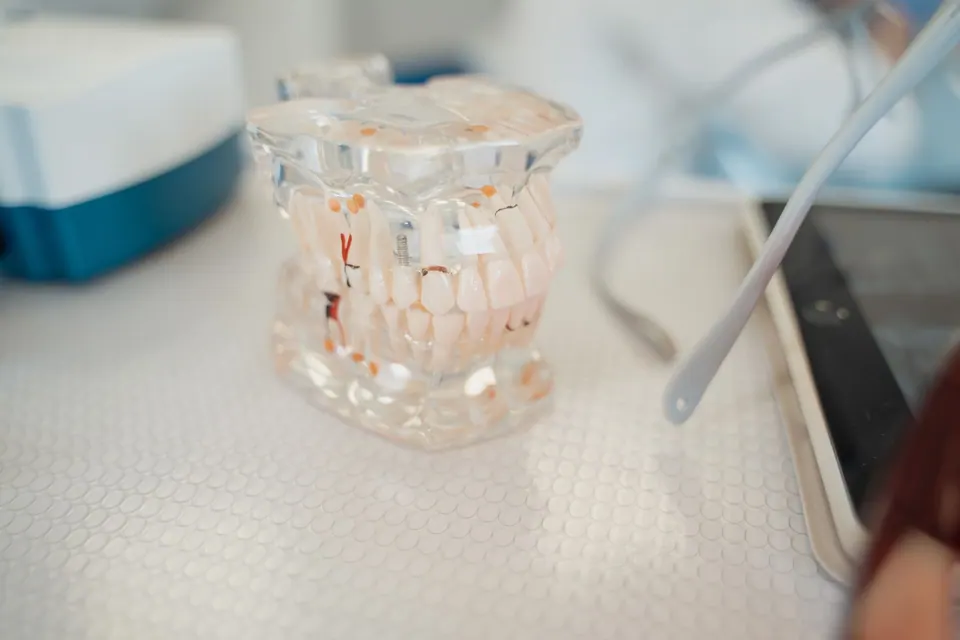
- With four implants, the two back implants are often placed at an angle. This tilt anchors them in the bone available in front of the maxillary sinus in the upper jaw, or in front of the mental foramen, where a sensory nerve emerges, in the lower jaw. It also brings support closer to the back teeth and shortens the unsupported, cantilevered part of the bridge.
- With six implants or more, the load is spread across more support points. This may be preferred in the upper jaw, where bone is often softer, in people who clench hard, or when the bone allows it without major grafting.
Other factors come into play: the desired length of the bridge, biting force, bone quality at each site and the safety margin should one implant run into trouble. Your dentist should explain why one number is recommended over another, so do ask.
The stages of treatment
A fixed full arch is designed from the future position of the teeth, working back to the implants:
- Assessment: examination of the mouth, gums, bite and opposing jaw, a panoramic X-ray and usually three-dimensional imaging to measure the bone.
- The aesthetic and functional plan: tooth length, lip support, smile line, speech. When a lot of bone and gum have been lost, the bridge includes a pink section that recreates the missing volume; the junction between this section and the gum must stay hidden behind the lip when you smile.
- Surgery: under local anaesthetic, teeth that cannot be kept are removed, the bone ridge is smoothed if needed and the implants are placed. Guided surgery can help follow the plan when indicated.
- The fixed temporary bridge: if implant stability allows, it is screwed in within a few days. It is lightweight and must be treated gently.
- Healing: over several months the implants integrate with the bone and the gum reshapes.
- The final bridge: a new impression is used to make a stronger prosthesis, for example a metal framework covered with resin or ceramic, or a zirconia structure.
The criteria that allow an immediate temporary bridge are explained in our article on immediate loading.
Cleaning and maintenance: the key to longevity
A fixed bridge on implants cannot decay, but the tissues around the implants can become inflamed if plaque builds up. Left unchecked, this inflammation can progress to peri-implantitis, a loss of bone around one or more implants.
Daily cleaning takes a few minutes longer than with natural teeth:
- careful brushing of every visible surface, including where the bridge meets the gum;
- cleaning under the bridge with stiff-ended floss, interdental brushes or a water flosser;
- a single-tuft brush for the areas around the back implants;
- a protective night guard if you clench or grind, when your dentist recommends one.
Maintenance visits are as important as the surgery itself. The dentist checks the gums, the tightness of the screws and wear on the bridge. Depending on the case, the bridge is periodically unscrewed so that the implants and the underside of the prosthesis can be cleaned thoroughly. A bridge designed to be cleanable, with no inaccessible areas under the pink section, is one of the signs of a well-planned treatment.
Alternatives to know about before deciding
A fixed full arch is not the only solution for a toothless jaw, nor always the most suitable:
- A conventional complete denture: no surgery, but often unstable, especially in the lower jaw, and it does not stop bone loss.
- An implant-retained denture: two to four implants fitted with attachments (press studs or a bar) hold a removable prosthesis. For the lower jaw, the McGill consensus statement proposed the two-implant overdenture as a minimum standard. It is easier to clean and its pink flange supports the lips well.
- A telescopic prosthesis: a very stable removable prosthesis that fits over copings attached to implants or retained teeth.
- Several segmented bridges on a larger number of dental implants: closer to natural teeth, but often requiring more bone or grafting.
Each option has its own advantages in terms of comfort, appearance, upkeep and budget. Our article on implant dentures versus telescopic prostheses compares these removable solutions in detail.
Questions to ask and your assessment in Rabat
Before committing to such a significant treatment, take the time to get clear answers:
- Why four or six implants in my case, and why not a removable solution?
- Will I have a fixed temporary bridge in the first few days, and what happens if that is not possible?
- What material will the final bridge be made of, and how is it repaired if it fractures?
- How do I clean it at home, and how often do I need to come back for maintenance?
- What happens if an implant develops a problem in a few years?
At German Dental Clinic in Agdal, a full-arch assessment is based on a clinical examination, digital X-rays and an intraoral scan, with planning that can draw on guided surgery. All options, fixed and removable, are presented with their constraints. If you live in or around Rabat and are considering replacing a whole arch, you can book an appointment for an initial opinion.
Frequently asked questions
Is an All-on-4 bridge taken out at night?
No, it is screwed onto the implants and only the dentist can remove it, for example during maintenance visits. Day to day, you clean it in place, adding special floss, interdental brushes or a water flosser to clean underneath. This is what sets it apart from an implant-retained denture, which you take out yourself.
Can All-on-4 be done if I lack bone?
Often yes, and that is precisely the point of tilting the back implants: using the bone available at the front of the jaw to avoid grafting further back. A sufficient volume is still needed in the front area, though. When bone is lacking everywhere, other approaches are discussed, such as grafting beforehand or more specialised techniques.
Can I eat normally with a fixed full arch on implants?
With the temporary bridge, a soft diet is needed during healing. Once the final bridge is fitted, most patients chew far more efficiently than with a denture. It is still wise to avoid biting very hard foods with the front teeth, as this puts heavy stress on the prosthesis and its screws.
Will I speak and smile normally?
A short adjustment period is common, especially for certain sounds, as the tongue has to get used to the new shape of the palate and teeth. The prosthetic plan is designed precisely to respect speech, lip support and a natural smile line, and the temporary bridge allows these to be fine-tuned before the final version.
What happens if an implant does not integrate?
It can happen, particularly in smokers or when implants are overloaded during healing. Depending on how many implants remain and where they are, the temporary bridge can sometimes be kept or adapted, and a new implant is placed after healing. This is one reason why the number of implants and the back-up plan are discussed from the outset.
The information on this page is general. Only a consultation allows a diagnosis and a suitable treatment plan.