Can you really have a fixed tooth on the day of the implant?
Yes, in carefully selected situations a fixed temporary tooth can be attached to the implant on the day it is placed, or within the following few days. This is called immediate loading. It is not reserved for a handful of exceptional cases, but nor is it suitable for everyone: it depends above all on how stable the implant is at the time of surgery, on the quality of the bone and on the way your teeth meet.
The appeal is obvious: no visible gap when you leave, no removable plate to wear for months, a complete smile sooner. But the tooth fitted that day is a temporary tooth, designed to protect healing, not the final tooth. Understanding this distinction prevents a lot of disappointment.
This article explains the criteria behind the decision, what actually happens, the precautions to follow and the situations where it is wiser to wait.
Immediate loading and immediate implants: two different things
Two ideas are often confused, although they describe different moments in treatment:
- When the implant is placed: it can go straight into the socket of a tooth that has just been removed (an immediate, or post-extraction, implant), a few weeks after the extraction, or once the bone has fully healed.
- When the implant is loaded: this is the moment a tooth, temporary or final, is attached to the implant.
The consensus conferences of the ITI (International Team for Implantology) distinguish immediate loading, carried out within the first week after placement, early loading, between one week and two months, and conventional loading, after a longer healing period.
The two can be combined: extraction, immediate implant and temporary tooth on the same day. But an implant can also be placed in healed bone and loaded straight away, or placed immediately and left unloaded for a while. Each combination has its own requirements, and your dentist will tell you which one suits your situation.
The criteria that make immediate loading possible
The final decision is only really made during surgery, once the implant is in place. Several conditions must be met:
- Sufficient primary stability: this is the mechanical anchorage of the implant in the bone immediately after placement. The surgeon assesses it from the resistance measured while the implant is screwed in (insertion torque) and sometimes with a resonance frequency measurement (ISQ value). An implant that is not completely immobile should not be loaded.
- Suitable bone volume and density: very soft or very thin bone gives less grip. The walls of the socket also matter, particularly the outer wall, which is very thin around the front teeth.
- A controlled bite: the way your teeth close together must allow the temporary tooth to be protected from chewing forces.
- No uncontrolled bruxism: grinding or clenching, especially at night, puts heavy forces on an implant that is still vulnerable.
- No acute infection at the site: active infection around the tooth to be removed may lead to postponing placement or loading.
- Favourable general health: poorly controlled diabetes, heavy smoking or certain treatments (head and neck radiotherapy, medicines that affect bone metabolism) call for extra caution.
This is why a responsible dentist always explains a plan B: if the stability achieved on the day is not sufficient, the implant is left to heal under the gum and a temporary solution that does not rest on it is provided.
What happens, step by step
Treatment usually follows these stages:
- Assessment: examination of the mouth, gums and bite, and X-rays. Three-dimensional imaging is often needed to measure the bone and locate the nerve in the lower jaw or the sinus.
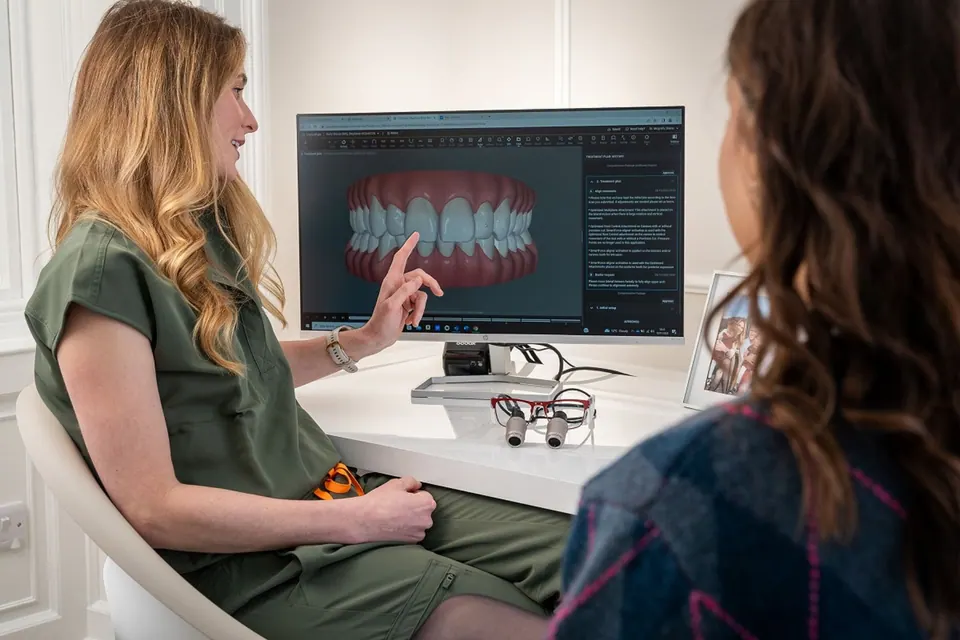
- Planning: the implant position is chosen according to the future tooth, not the other way round. A digital impression and guided surgery, when indicated, help transfer this plan to the mouth accurately.
- Extraction if needed: if the tooth is still present, it is removed as gently as possible to preserve the bone walls.
- Implant placement under local anaesthetic, followed by a check of its stability.
- The temporary tooth: it is attached to the implant, usually within a few hours. For a single tooth, it is generally adjusted so that it does not touch the opposing teeth.
- Follow-up: regular checks during healing, then the final tooth is made.
When a tooth extraction is followed by an immediate implant, the quality of the extraction determines much of the outcome. When an immediate implant is not reasonable, socket preservation can prepare the site for later placement.
Temporary tooth and final tooth: two separate stages
The tooth fitted on the day of surgery is almost always a temporary tooth, often made of resin. It has three jobs: sparing you a gap, guiding gum healing so that a natural contour forms around the implant, and testing the appearance before the final version.
During osseointegration, bone gradually bonds to the implant surface. This phase generally takes several months and the temporary tooth does not speed it up: on the contrary, it has to be protected. Hence a few simple rules:
- a soft diet for the first weeks, without biting into anything with the temporary tooth;
- no hard or sticky foods, and no fruit stones, on that side;
- gentle but thorough cleaning around the gum;
- contact the practice promptly if the temporary tooth moves, comes loose or cracks.
Once integration is confirmed and the gum has stabilised, an impression, often digital, is used to make the final crown in ceramic or zirconia, which is stronger and more natural-looking. For a full arch the logic is the same: a fixed temporary bridge, then a final bridge. Advice for the days after surgery is set out in our aftercare guide for dental implants.
Benefits, limits and risks
The benefits are real when the case is suitable:
- no period with a visible gap, which matters greatly in the smile zone;
- no removable transitional denture to wear;
- gum shaping from the outset, which helps the final appearance;
- considerable psychological and social comfort.
The limits should be understood before you commit:
- not everyone is a candidate, and the plan can change during surgery;
- the temporary tooth requires strict eating discipline for several weeks;
- an implant exposed too early to excessive forces may fail to integrate, in which case it has to be removed and the procedure repeated after healing;
- in the aesthetic zone, an immediate implant placed in a socket with a very thin wall carries a higher risk of gum recession over time.
Recovery is the same as after any dental implant procedure: swelling, sometimes bruising, temporary discomfort and, more rarely, infection. When selection criteria are respected, the literature describes immediate loading as a valid option; when they are not, waiting remains the safest decision for the implant and for you.
Questions to ask and the assessment in Agdal
Before promising you teeth on the same day, the dentist needs to have examined your situation in detail. A few useful questions to ask at the consultation:
- Do my bone and gums allow an immediate implant, or should the area heal first?
- What happens if stability is not sufficient on the day of surgery?
- Will the temporary tooth be fixed, and what will it be made of?
- How long will I need to protect it, and when will the final tooth be made?
- Does my grinding, smoking or medical treatment change anything?
At German Dental Clinic in Agdal, the assessment combines a clinical examination, digital X-rays and an intraoral scan, and guided surgery can be used when it brings a benefit. You leave with a clear explanation of the possible options, including when a staged approach is the more prudent choice. If you live in Rabat and would like to know whether immediate loading could work in your case, you can book an appointment.
Frequently asked questions
Is the tooth fitted on the same day the final tooth?
No, it is almost always a temporary tooth, usually made of resin, designed to protect the implant while it heals and to shape the gum. The final crown, in ceramic or zirconia, is made once the implant has integrated with the bone, generally after several months. The timing depends on your bone and the area treated.
Can I chew normally with an immediately loaded tooth?
Not at first. For the first weeks you are advised to eat soft food and avoid biting with the temporary tooth, even if it feels solid. For a single tooth, it is often adjusted so that it does not touch the teeth opposite. Your dentist will tell you when you can gradually return to a normal diet.
Is immediate loading riskier than conventional placement?
When the criteria are met, in particular good primary stability and a controlled bite, it is considered a valid option. The risk increases if the implant is subjected to heavy forces during healing, which is why case selection and following instructions matter so much. If stability is insufficient on the day, the dentist will prefer to wait.
Is it possible for an infected front tooth?
It depends on how extensive the infection is and on the condition of the bone around the root. A limited chronic infection can sometimes be carefully cleaned out during the extraction, but an acute infection or a destroyed bone wall often leads to postponing the implant or its loading. Only an examination and imaging can settle the question.
Can a whole arch be fixed on the same day?
This is a common approach for full arches on several implants: they are joined by a fixed temporary bridge that spreads chewing forces between them. It requires a precise assessment, bone able to stabilise each implant and careful follow-up during healing. The final bridge is made at a later stage, once the implants have integrated.
The information on this page is general. Only a consultation allows a diagnosis and a suitable treatment plan.