Inlays and onlays: what are they?
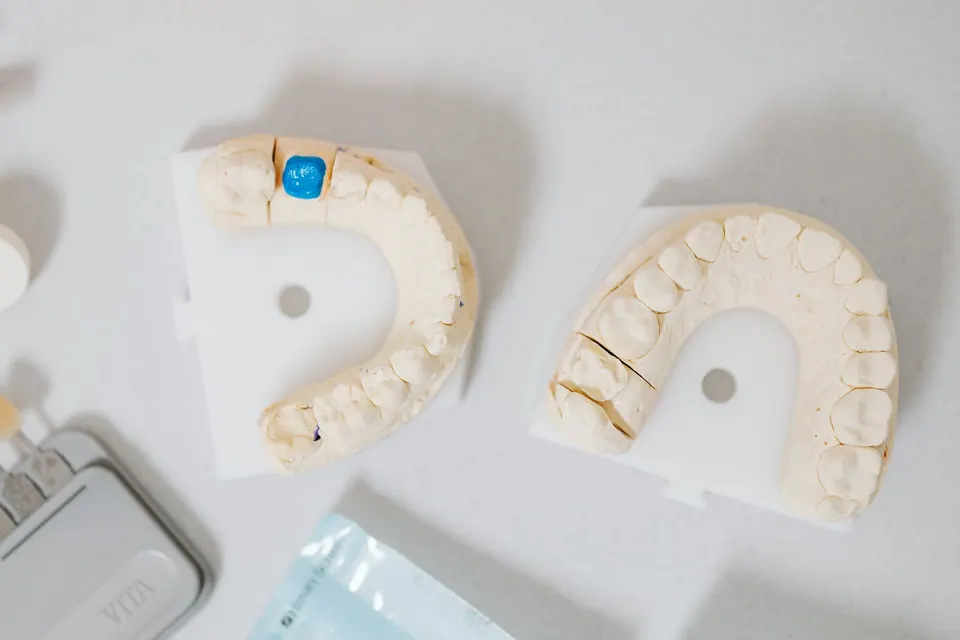
Inlays and onlays are partial restorations made to measure outside the mouth and then bonded to the tooth. An inlay fills a cavity inside the tooth, between its pointed cusps. An onlay goes further and covers one or more cusps to protect them. When it covers the entire chewing surface, it is sometimes called an overlay.
They are mainly used on premolars and molars. Their value lies in sitting between two classic solutions: the direct composite filling, placed in a single step in the mouth, and the crown, which covers the whole tooth after it has been reduced all the way round.
The principle is simple: remove the diseased tissue, keep as much healthy enamel and dentine as possible, and rebuild precisely what is missing. This minimally invasive approach relies on adhesive bonding, which joins the ceramic to the tooth without needing to cut large mechanical retention shapes.
When to choose one over a filling or a crown
The choice mainly depends on how much tooth has been lost and what remains around it. An inlay or onlay is often discussed in the following situations:
- a large cavity after decay or removal of an old amalgam, too wide for a direct filling to keep good contact points and a durable shape;
- weakened cusps that are thin or cracked and are better covered to prevent them breaking;
- a root-filled back tooth whose walls are still thick enough: an onlay can protect it without as much reduction as a crown;
- replacing several old fillings on the same tooth.
On the other hand, a small cavity is generally treated very well with a direct filling, which is simpler and more conservative. This is the first level of tooth decay treatment. And when the tooth is badly broken down with few walls left, a dental crown is often more appropriate.
The dentist reasons wall by wall: remaining thickness, cracks, height of the tooth and where the margins sit relative to the gum.
Ceramic, composite or gold: the materials
Several materials can be used, each with its own profile:
- Lithium disilicate: a reinforced glass ceramic that is strong and translucent. It is a frequent choice for onlays because it combines strength with a natural look once bonded.
- Feldspathic ceramics: highly aesthetic but more fragile before bonding, suited to areas under little load.
- Hybrid materials and milled composites: slightly less hard than ceramic, easier to adjust or repair, sometimes proposed in specific situations.
- Gold: widely used in the past for its tolerance and precision, now less requested for aesthetic reasons.
Ceramic has several strengths: colour stability, a smooth surface to which plaque adheres poorly, and good acceptance by the gum. It does not scratch or stain over the years the way composite can. The choice of material takes into account the position of the tooth, the strength of your bite and any clenching habit. Our article e.max or zirconia explains the difference between these families of ceramics.
The steps, from preparation to bonding
A typical ceramic inlay or onlay follows these steps:
- Diagnosis: examination, X-ray and assessment of cracks and walls.
- Preparation under local anaesthetic: removal of decay or the old filling, then shaping of the cavity with rounded angles and enough room for the ceramic. Deep areas may be built up with bonded composite, and freshly cut dentine is often sealed straight away to protect it.
- Impression: an intraoral scanner records the tooth in three dimensions, without paste, together with the opposing tooth and the bite.
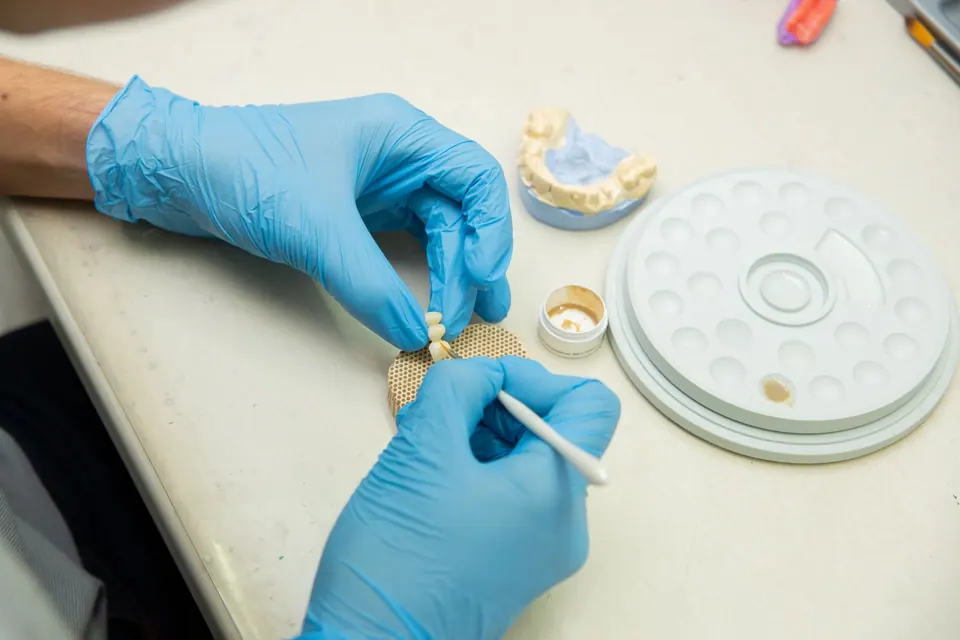
- Design and fabrication: the restoration is designed on a computer and milled from a ceramic block. With a CAD/CAM milling unit, this can be done in the practice.
- Try-in: checking the fit, contact points and shade.
- Bonding: with the area isolated, ideally under a rubber dam, the tooth and ceramic surfaces are treated and joined with a composite cement.
- Bite adjustment and polishing.
Depending on the situation, everything can sometimes be done in one visit; in other cases a temporary restoration is placed between two appointments. Timing also depends on whether the chosen ceramic needs a crystallisation or glaze firing.
Honest advantages and limitations
The main advantages of a well-indicated inlay or onlay:
- more healthy tissue preserved than with a crown, with margins often above the gum where they are easier to check and clean;
- precise anatomy and contact points, since the restoration is made outside the mouth;
- wear resistance and colour stability of ceramic;
- the option of a crown later if needed, as the tooth has not been reduced all the way round.
There are also limitations:
- bonding is technique-sensitive and needs a dry field, which can be difficult when the cavity extends deep below the gum;
- grinding or clenching increases the risk of fracture and must be taken into account;
- poor hygiene, as with any restoration, exposes the tooth to decay at the edge of the restoration;
- the treatment takes more time and skill than a direct filling.
An inlay or onlay is therefore not "better" in absolute terms: it is worthwhile when it matches the real condition of the tooth.
After placement: care and longevity
Once bonded, the onlay becomes one with the tooth and you can eat normally as soon as the anaesthetic has worn off. Mild sensitivity to cold or chewing may occur for a few days, especially after a deep cavity. If it persists or gets worse, let your dentist know.
How long a bonded restoration lasts depends on many factors: quality of bonding, ceramic thickness, chewing forces, hygiene and follow-up. A few habits help it last:
- clean between your teeth every day with floss or suitable interdental brushes;
- avoid biting hard objects (stones in fruit, ice cubes, pens);
- wear a night guard if grinding has been diagnosed;
- have the margins of the restoration and your bite checked regularly.
A small chip can sometimes be polished or repaired with composite. A larger fracture or decay at the margin means the restoration has to be remade, and the tissue saved at the outset usually leaves room for a new one.
Questions to ask and assessment in Agdal
Before choosing between a filling, an onlay and a crown, a few questions help you understand the proposal:
- How many healthy walls are left on my tooth, and are they cracked?
- Why cover this particular cusp rather than keep it?
- Which material are you proposing, and why for this tooth?
- Can bonding be done with good isolation?
- Do I show signs of clenching that call for protection?
At German Dental Clinic in Agdal, the impression can be taken with an intraoral scanner and the restoration designed and milled in the practice using CAD/CAM, when the case allows. The final choice always depends on the examination of your tooth. If you are in Rabat and have been told a large filling needs redoing, you can book an appointment to discuss it.
Frequently asked questions
What is the difference between an inlay, an onlay and a crown?
An inlay fills a cavity inside the tooth without covering its cusps. An onlay covers one or more cusps to protect them. A crown surrounds the whole tooth after it has been reduced all the way round. Moving from inlay to crown gives more complete protection, but removes more tooth tissue.
Will a ceramic inlay be visible?
Usually very little. The ceramic is chosen in a shade close to the tooth and, once bonded, lets light through in a way fairly similar to enamel. The junction between the restoration and the tooth may remain slightly visible close up, depending on shade and thickness.
Can an onlay be placed on a root-filled tooth?
Yes, in many cases, when the remaining walls are thick enough and the root canal treatment is sound. The onlay then covers the cusps to reduce the risk of fracture. If the tooth is very broken down, a crown, with or without a core build-up, may still be preferable. The choice is made after examination.
Can an old amalgam filling be replaced with an inlay?
This is a common reason when the amalgam is large, cracked or surrounded by decay. Removing a sound amalgam purely on principle, however, is not routinely advised. Your dentist assesses each filling and explains whether replacing it is worthwhile.
Can an onlay be fitted on the same day?
Sometimes. With a digital impression and in-house CAD/CAM fabrication, the restoration can be designed, milled and bonded on the same day when the situation allows. A very sensitive tooth, a very deep cavity or difficult isolation may mean planning two visits instead.
The information on this page is general. Only a consultation allows a diagnosis and a suitable treatment plan.