What is a sinus lift?
A sinus lift, or sinus augmentation, is a procedure that increases the height of bone available in the back of the upper jaw, beneath the maxillary sinus, so that an implant can be placed there. The surgeon gently lifts the thin membrane lining the floor of the sinus and places graft material in the space created. This new bone then anchors the implant.
It is a common, well-established technique in implant dentistry. It does not involve the nose and does not change your breathing, and it is usually carried out under local anaesthetic. There are two main approaches, the lateral approach and the crestal approach, chosen according to how much bone remains.
A sinus lift is one type of bone graft. Our article on bone grafting before an implant covers the other reconstruction techniques.
Why bone is lacking under the sinus
The maxillary sinuses are air-filled spaces in the facial bones, above the upper premolars and molars. In some people, the roots of these teeth naturally sit very close to the sinus floor.
After an upper molar is lost, two processes combine:
- ridge resorption: the bone that surrounded the root is no longer stimulated and shrinks in both height and width;
- sinus expansion (pneumatisation): the cavity tends to enlarge downwards into the space left behind.
An old infection, advanced periodontitis or a difficult extraction can make the loss worse. As a result, sometimes only a few millimetres of bone remain between the mouth and the sinus, too little to stabilise a standard-length implant.
This is one reason why it is worth thinking about replacing an upper back tooth fairly soon after it is lost, before the situation progresses.
Lateral or crestal: two approaches
The choice of technique depends mainly on the remaining bone height and on the anatomy of the sinus.
- The crestal approach (or osteotome technique): access is through the hole prepared for the implant, at the top of the ridge. The surgeon raises the sinus floor in a controlled way, sometimes adds a little graft material, then places the implant in the same session. This approach is less invasive, but it only allows a moderate gain in height and requires enough bone to stabilise the implant.
- The lateral approach: a small window is opened in the outer wall of the bone, on the cheek side. The sinus membrane is released and lifted under direct vision, and the space is filled with graft material. This allows a greater gain in height. The implant is placed at the same time if the remaining bone gives enough stability, otherwise at a later stage.
The material may be bone taken from the patient, a treated substitute of animal or human origin, or a synthetic material, sometimes mixed. A membrane is often used to cover the lateral window. Your dentist will explain the choice made and why.
The assessment before surgery
A sinus lift is prepared carefully. The assessment includes:
- an examination of the mouth, gums and bite;
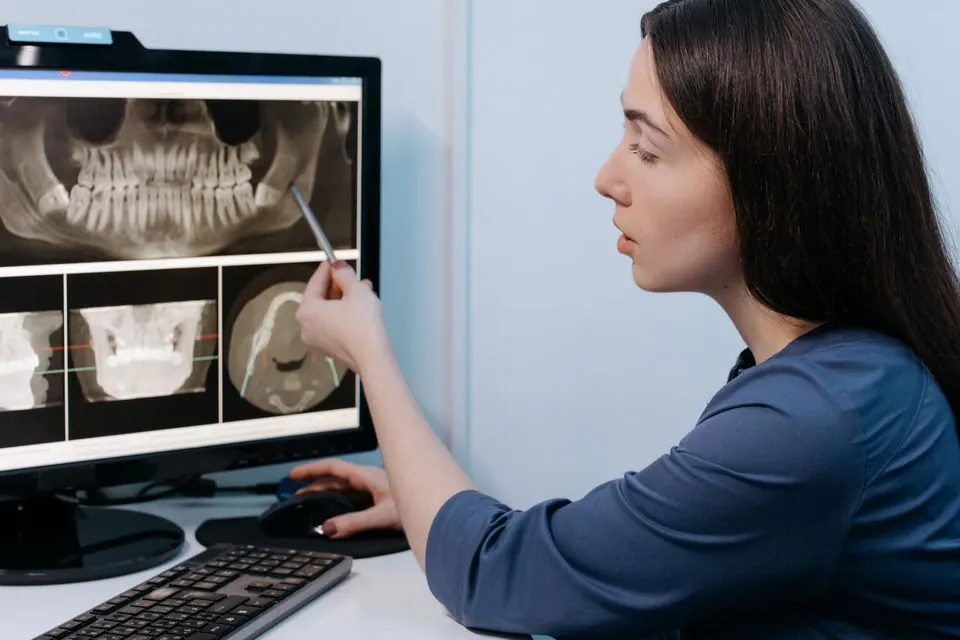
- three-dimensional imaging, essential to measure the remaining bone, see the shape of the sinus, identify any bony partitions (septa) and the path of blood vessels;
- an analysis of the sinus itself: thickening of the lining, a cyst or signs of chronic sinusitis are looked for;
- a full medical questionnaire.
If you have a history of recurrent sinusitis, polyps or an abnormality visible on imaging, an opinion from an ear, nose and throat (ENT) specialist may be requested before surgery. Active sinusitis is a contraindication until it has been treated.
Other factors increase the risk of complications and are discussed case by case: smoking, poorly controlled diabetes, head and neck radiotherapy, certain medicines that act on bone, or gum disease that has not been stabilised.
The procedure and healing
The procedure is usually carried out in the practice under local anaesthetic:
- the gum is opened to reach the bone or, for the crestal approach, the implant site is prepared;
- the sinus membrane is lifted with dedicated instruments, taking care to keep it intact;
- graft material is placed beneath the membrane;
- the implant is placed if conditions allow;
- the gum is closed with stitches.
The length of the procedure depends on the technique and the number of sites. Then comes a period of graft maturation, during which new bone gradually grows into the material. It generally lasts several months, more or less depending on the material, the volume grafted and your situation. If the implant was not placed at the same time, it is placed after this period, and the crown is made once the implant has integrated.
This timeline can feel long, but it underpins the strength of the whole result. Placing a dental implant in well-rebuilt bone allows a correctly positioned crown that is easy to keep clean.
After surgery: what is normal and what should alert you
In the first days, several things are usual:
- swelling of the cheek, often at its peak around the second or third day;
- bruising that may spread under the eye or across the cheek, then gradually fade;
- a slight nosebleed, or a blocked feeling in the nose on the treated side;
- discomfort controlled by the prescribed medication.
To protect the membrane and the graft during the period your dentist specifies:
- do not blow your nose hard, and sneeze with your mouth open;
- avoid strenuous exercise for the first few days;
- avoid flying, diving and playing wind instruments until your dentist allows it;
- do not smoke;
- follow the prescribed treatment, which may include a nasal decongestant, and the mouthwash;
- eat soft, lukewarm food and do not chew on the treated side.
Contact the practice without delay if you have a fever, thick or foul-smelling nasal discharge, pain or swelling that increases after the third day, small granules of material coming out of the nose, or air or liquid passing between the mouth and the nose.
Risks, alternatives and assessment in Agdal
The most common complication during the procedure is a perforation of the sinus membrane. Depending on its size, it can often be repaired straight away, for example with a collagen membrane; sometimes the surgeon prefers to stop and try again after healing. Less often, postoperative sinusitis or infection of the graft occurs, requiring prompt treatment.
A sinus lift is not always the only option. Depending on the bone available, other solutions may be discussed:
- short implants, when the bone height allows;
- tilted implants, placed in front of the sinus;
- a bridge on natural teeth or a removable prosthesis;
- for very severe bone loss, highly specialised techniques such as zygomatic implants, reserved for specific indications.
Our article on not having enough bone for an implant compares these approaches. At German Dental Clinic in Agdal, the assessment is based on a clinical examination, digital X-rays and an intraoral scan, supplemented by the imaging required, so that we can explain clearly whether a sinus lift is useful in your case or whether an alternative is preferable. If you live in Rabat and a sinus augmentation has been mentioned to you, you can book an appointment to discuss it.
Frequently asked questions
Is a sinus lift painful?
The procedure is carried out under local anaesthetic and is generally not painful at the time. In the following days, the main sensations are swelling, sometimes bruising and a feeling of pressure in the cheek, more marked with the lateral approach than with the crestal one. The prescribed treatment usually keeps this discomfort well under control.
Can I fly after a sinus lift?
Pressure changes in the aircraft cabin can strain the sinus membrane while it heals. It is therefore advisable to avoid flying for the period your dentist indicates, which depends on the technique and how the procedure went. If you have a trip planned, mention it at the planning stage so that the date of surgery can be adjusted.
How long do I have to wait before the implant is placed?
When the implant is placed at the same time as the graft, no second surgery is needed, but you must wait for it to integrate before the crown is made. When it is placed later, a maturation period of several months is generally required. The exact timeline depends on the material used, the volume grafted and your situation.
Can a sinus lift cause sinusitis?
It is possible but uncommon when the sinus is healthy before surgery and instructions are followed. This is why the preliminary assessment looks for chronic sinusitis or any sinus abnormality, and why an ENT opinion is sometimes requested. Thick nasal discharge, fever or increasing pain should prompt a quick consultation.
Can smokers have a sinus lift?
Smoking reduces blood supply and increases the risk of complications and graft failure. Stopping smoking before the procedure and throughout healing is strongly advised. For a heavy smoker who cannot stop, the dentist may consider that the procedure is not reasonable and suggest another solution.
The information on this page is general. Only a consultation allows a diagnosis and a suitable treatment plan.